6 October 2024 – 15 January 2025
artists: Iveta Schovancová, Martin Zetová, Ondřej Konrád, Laura Gozlan, Aleksandra Vajd, Bára Mrázková, Leevi Toija, Jen Kratochvil, Hynek Alt
Jen Kratochvil, Hello, Stranger
Hello, stranger
Stranger when we meet, stranger danger, strangers in the night
Perfect stranger, strangers on a train, strangers in this town, the stranger
L’étranger, A Streetcar Named Desire, Stranger than Paradise, Stranger Things
The Second Sex, Strangers to Ourselves, Sister Outsider
1949, 1991, 1984
Strange encounters…
2000
Hello, hello, to you all
I started using they/them pronouns very recently—it hasn’t even been months, barely weeks. In Czech, I like to oscillate between ona/on (she/he), though almost nobody knows, only a few close people, some of whom even told me that they’ve been using they/them pronouns for me for a while without me knowing.
Lacking the Gen-Z drive and emphasis on the weight of words—after all, growing up in the 90s, at the end of history, brought a great societal relief and relaxation from the necessity of precise language—I’m not trying to alert anyone or scold them, and everything flows rather gradually.
Every day brings a new need to acknowledge the value of words, their meaning, and relevance in shaping the delicate fabric of reality, which we navigate with varying or more personal challenges.
I thought the phrase “stranger danger” originated in the North American suburban dystopia of McCarthyism, but surprisingly, it came in the late 60s, more in the 70s and 80s. They probably needed time to configure their family totalitarianism. Stranger danger was a warning from teachers and parents about the danger of “strange” people. Vietnam, the War on Drugs… other tools of aggressive imperialism, social normalization, and systemic racism had the simple phrase to protect future generations: stay away from strangers, dear daughter, dear son.
Perfect stranger, strangers on a train, strangers in this town, the stranger
L’étranger, A Streetcar Named Desire, Stranger than Paradise, Stranger Things
The Second Sex, Strangers to Ourselves, Sister Outsider
1949, 1991, 1984
Strange encounters…
2000
Hello, hello, to you all
The strangest and, in fact, the most telling reaction to any public change of designation, naming, or visible transformation of identifying signs is the question: “So how do you feel now?” as if a switch inside a person had been flipped and they suddenly became someone else.
Coconut trees, my dears, coconut trees
L’étranger, A Streetcar Named Desire, Stranger than Paradise, Stranger Things
The Second Sex, Strangers to Ourselves, Sister Outsider… strange encounters…
Hello,
How many nights in one place make it home? How many times do you have to wake up, exercise, drink coffee, go about your day, then floss, use a sonic toothbrush, mouthwash, exercise, gentle light, no light, voice, warmth, quiet, peace, and unrest—
Is home the place where clothes aren’t in a bag, and the laptop is replaced by an iMac on the desk?
How many train, bus, and plane tickets fit into one head in one week?
And then you wake up in the Czech birch, and everyone lets you know that everything is alright.
The Second Sex, strange encounters…
2000
Hello, hello, to you all
We live in an age where words, each individual word, bear on their shoulders the Parthenon of reality.
People, we’ll return the billion the government took from you.
We’ll return the freedom taken by the European Union.
We’ll return it, freedom, people—
Genocide, imperialism, Iron Dome, the right to defend, ownership, belonging, heritage, legacy, tradition, culture, family, war—
Ping pong—
So how many Parthenons is that, really, when each heavy word means a different thing to a different audience?
We’ll return freedom, people.
Home is an extremely slippery concept and requires a lot of work, which not everyone can manage, nor does everyone have to—the concept of a stranger, wow, that’s next level.
Hello, hello, dear stranger
There’s no danger around here,
although who knows…
Stranger danger contains a strange dual tension; on one hand, a stranger can be a danger, and on the other, everything around is dangerous for a stranger—which is more likely.
The decisive factor, however, is the question of who points the finger and says who is a stranger and who isn’t.
Hello, stranger
Sometimes it’s really hard to take all this in—
for a moment, it seemed like there would never be any strangers again because, after all, we live together in one place, somewhere in a vacuum.
And now…
Hello, stranger, we all need closeness, communities, and support systems.
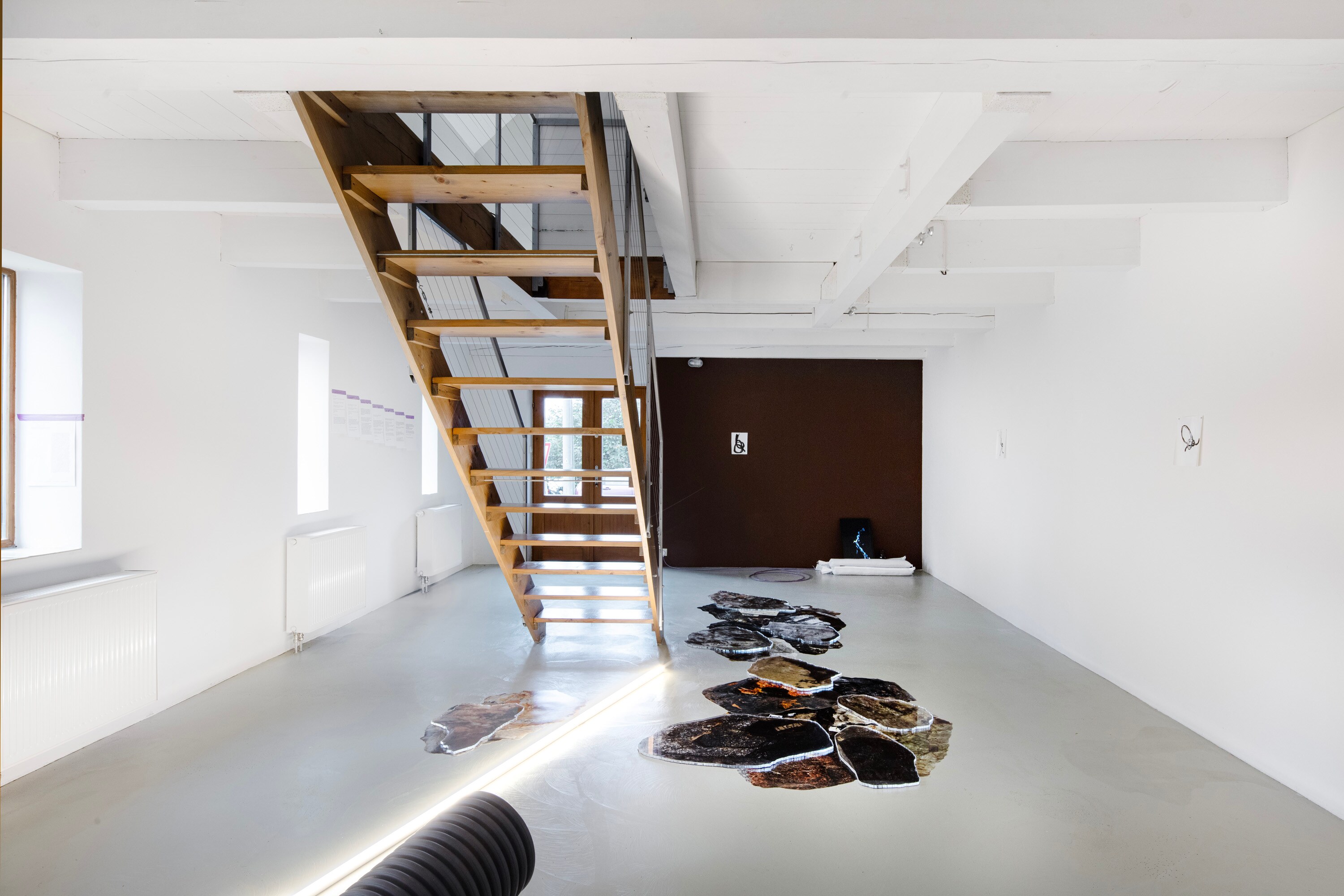
This exhibition is a double of another exhibition, or vice versa—they met by fax, they know each other from afar.
The concept of doubling seems to be a formative precondition of humanity: pairs, doubles, twinning, two-handed, polarity, binarity, two poles, two mugs, two cars, two convictions.
Deconstructing binarity and unlearning its seductive adherence is a task for another civilization.
There is only one truth, there is no truth, there are many truths, there are two truths, there are as many truths as there are sides, there are too few truths, there are too many truths, untruth prevails, and enough with the pathos.
Hello, stranger, don’t be a stranger.
Jen
in Česká Bříza, October 5th, twenty-twenty-four