Pavel Vančát, AV/HA
Pavel Vančát
AV/HA: PHOTOGRAPH’S GENOME
(I have observed the art of Aleksandra Vajd and Hynek Alt for 15 years not only as a professional and critic but also a good friend and sometimes a curator of their exhibitions. Therefore, it is more complicated to find the right words, approach and diction with respect to their work. Everything is also more difficult since I know that to write about AV/HV is also to write about bases, my own ambitions, doubts and me. Nevertheless, let us try to decrypt this difficult conundrum.)
(territories/languages) Just to be clear right from the start, we shall drily remark that Aleksandra Vajd and Hynek Alt (hereinafter only referred to as AV/HV) form not only a duo of artists but they are also husband and wife and they raise their now pubescent son (TA) and at the same time, they have been the heads of Studio of Photography at the Academy of Arts, Architecture and Design in Prague since 2008. Therefore, it is not an intrusive personal remark that their early large timelapse project “manwomanunfinished” (2000–2008??) engaged in the mutuality and photogenic looks of the relationship of two photographers and their gradual change in time. Thus, we can retrospectively define the AV/HA carrier, besides other things, as a description of one love affair with its passions, difficulties, fights and success. Their partnership in art thus creates a public and visible layer of their long-standing and multi-layered dialogue in which the duality of the artist’s ego demands constant empathy leading to a long-term and conciliatory merging.
To make things more complicated, the AV/HA household is a territory of three overlapping languages (similarly as in the case of this publication) that inevitably refine the sensitivity to a language and cultural differences. The same as the first generation for which the passableness of European borders (despite sporadic amazement) is a fact, they rarely express themselves on the issues of local sentiment. And they approach the language of photograph the same: its use is always temporary, final and partial in some way. It is a language that functions as a spell. This patient enchanting of a photograph disguises the completely intentional glide rate of continual mental plan views.
The fundamental topic around which the work of AV/HA has been revolving around in past ten years is the shift of meanings both interpersonal and on the basis of photograph itself. Thus, the photograph as a trap – optical, mental, social and emotional – becomes a medium that does not show much but rather constantly asks. It is not a photograph as a window but as a black hole.
(tools) The Department of Photography of Film and TV School of Academy of Performing Arts in Prague of the second half of nineties when AV met HA still had been an oasis of the orthodox “Photograph” (with capital F) just the way the “Photographers” had been building it since the seventies. The Internet and digital cameras had been a science fiction. (Defining the starting point can retrospectively help understanding the radicality of following objectives.) Whilst the original photographic trainings of AV/HA result from the traditional document (Viktor Kolář) and visualism of the 70’s and 80’s (Štěpán Grygar) and include the technical and professional elegance and respect to the craft, I dare to say that there were two other factors playing more significant role in their artist development. First and foremost, their meeting and the following study at the State University of New York at New Paltz (Fulbright Programme) broadened their horizons, extending beyond the tradition of the “Photograph”. Then AV/HA turned outside themselves towards the tradition of modern art itself and depiction in general. In this respect, AV/HA represent (along with for example Markéta Othová and Jiří Thýn) apostles of post-photographic U-turn to the “meta-photograph” in the Czech artistic world. The “meta-photograph” uses the photograph’s characteristics and criteria as a physical material and as a general topic concurrently but it is firmly interconnected with them and also connected to the more general art operation.
(method) AV/HA know very well that the same as the most fundamental scientific findings are often the result of sophisticated and unexpected coincidence, it is often necessary, with respect to the process of photograph characteristic verification, to make an intentional mistake or better to force the viewer to make it.
And that is the reason why their works often move between the analysis and conjuring, super modern laboratory and child’s (or hipster’s) room. In the end, everything is subordinate to the fundamental and the highest (almost utopian) objective: to fully (and if possible, in an interesting way and engagingly) map the genome of photograph itself, therefore all its nuances and possible dysfunctions. With regard to the above-hinted, it means not only to decipher one-self’s genome but the genome we all share: acknowledged, naive and nowadays vitally important trust in the photographic image.
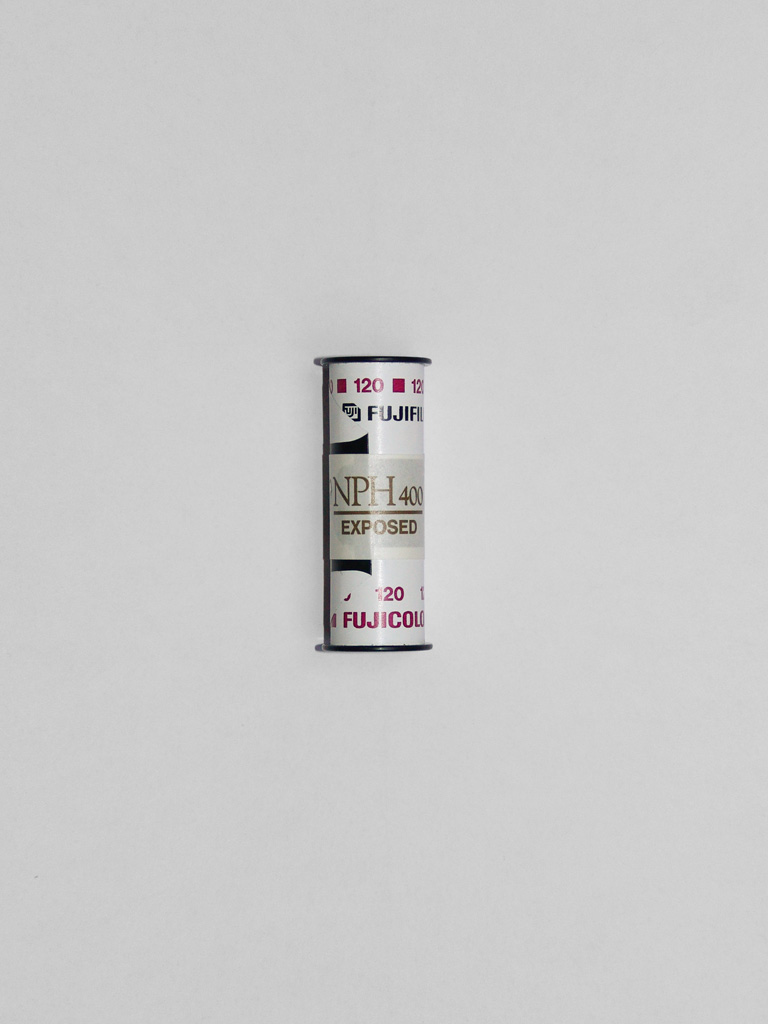
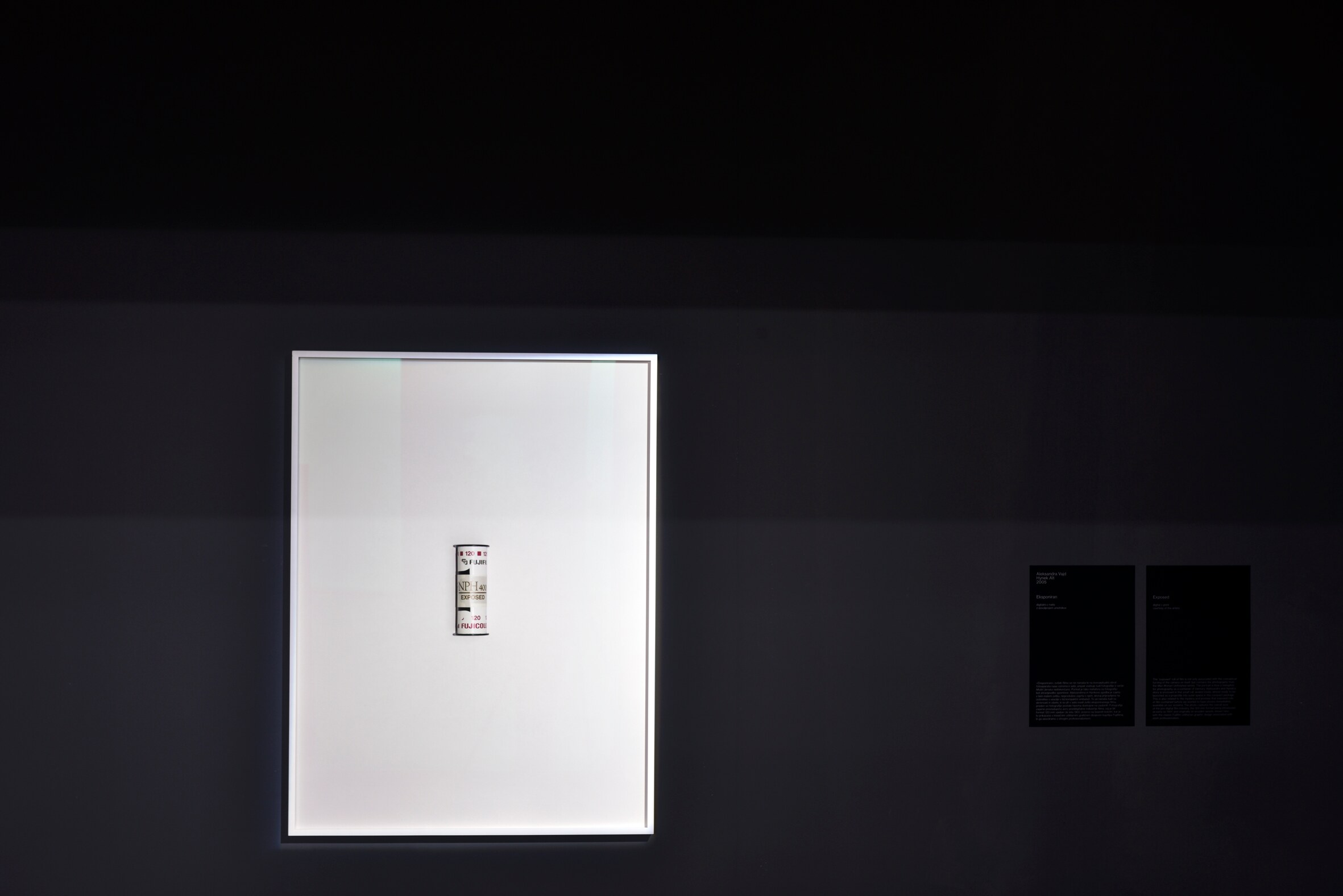
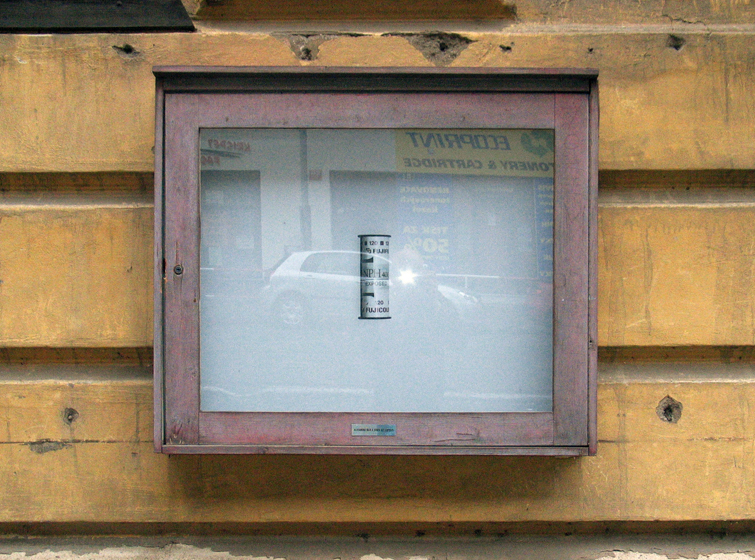
From this perspective, I consider the photograph called Exposed, which was exhibited in Prague in 2005 in the street showcase of the Art Group Bezhlavý jezdec (Headless Rider) at the moment of their return to Prague, as crucial and fundamental work of AV/HA. The photograph of the role of film that had been already exposed and which become a photographed exhibit at the same time is a perfect, simple shortcut of their approach to the photograph. (It is likely that the roll of film contains one of the last images of the cycle “manwomanunfinished” and thus it forms their abstract mutual self-portrait exposing the photographic trap on the operating table in the state of sudden vulnerability.) This approach consequently leads AV/HA to many purely “genome” projects.
AV/HA then developed the above-mentioned approach to the photograph as to the mummified mammoth when teaching and they helped to grow the following generation of artists through it. Artists who freely and naturally take stand among the many methods and media and who constantly test (and thus innovate) the bases of their own mentors. After six years, such educational practices stopped to be an anomaly and it became a new tradition (in between, the technological future of 90’s managed to squeeze even into cheap Chinese smartphones).
(application) If I should, instead of describing particularities, name the significant quality of AV/HA works in some manner, it would be a little paradox connection of systematic nature and style. Due to the fact that I can observe AV/HA work in the long term and closely, I tend to be touchy with respect to their formal brilliance. However, a strong echo of the design-based approach covers the content of their works only seemingly: the design is represented as the content itself and vice versa in the end. The reconciliation with own definition can be also perceived as a platform on which other anomalous stimuli can be drawn. The stimuli show small fragments of antimatter on the background of formal perfection.
What is more, the above-mentioned “genome” project started to be too restrictive for AV/HA in past years and it lead them to expanding in other spatial media, the same as to permeability of media throughout exhibitions, publications and performances. From this perspective, I consider the exhibition You Can’t Change the Weather (etc. gallery, 2011) fundamental. In the course of the exhibition, the Prague gallery transformed into a meteorological laboratory which was translated to an almost abstract coloured photographic brochure.
Thus, AV/HA not only naturally leave the paradigm of “Photograph” in which the book or exhibition are only an ideal selection of best shots but they also show the photograph itself as an arbitrary code while keeping the distance: a medium subordinate to and fixed in many other media. If I return for the last time to the genome we can say that AV/HA bear the photograph’s genes in themselves so that they can subject them to the astonishment and criticism. The constant distancing from and closing to the continually changing medium has become a natural dance in between occasional explosions which they present to the viewers and disciples with intelligent gracefulness.
More texts