Ever since photography was gradually incorporated into the practice and teaching of art, it has remained a new medium, but photography is also a format that is closely associated with the past, with issues concerning the media representation of reality and its physical presence. This naturally raises questions about the manipulation and distribution of our images, emotions and ideas, about the politics of time, social memory and aesthetic sensibility. Hynek Alt has long explored these “photographic” problems. He works with photography’s formal qualities and inner history, including in relation to other media and documentary photography, as for instance in Untitled (Bud) and Untitled (Sculptures in the Air), 2020, and also in relation to the social unconscious, which can well up from street works – Untitled (Infrastructures & The Beach), 2017–2020 – and libidinal loops, as in Untitled (Lady Dee) and Untitled (Spejbl, Ketamine), 2020. He frequently stresses photography’s fragility and its mass-produced and iconic character, for instance by adding an installation of stacked posters that can be taken away, or by using image databases.
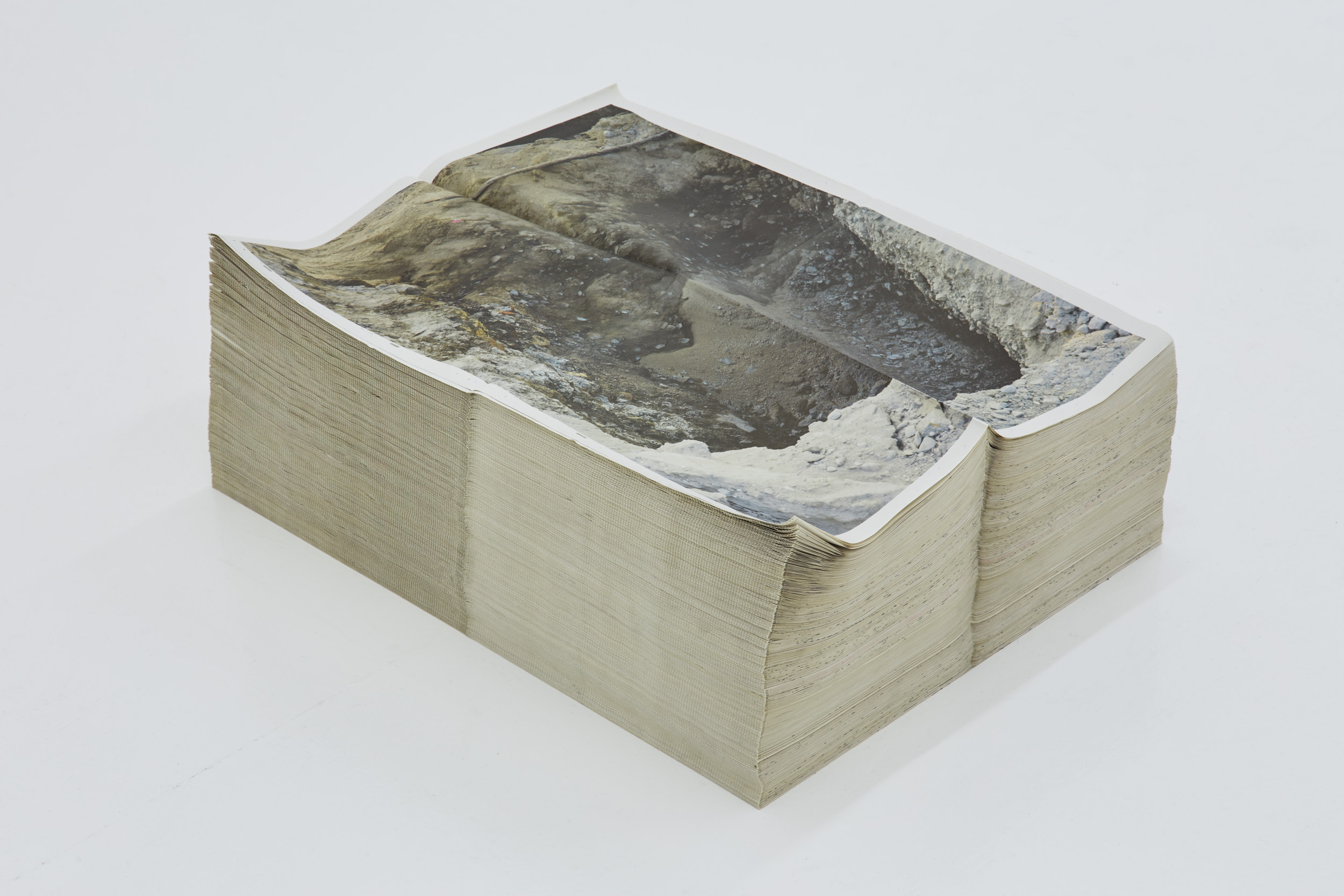
His project Untitled (Today), 2020 combines practically all of these elements. It involves a stack of photographs printed by presses belonging to MAFRA, the largest Czech media company. The photographs are taken from the series Untitled (Infrastructures & The Beach), which uses images of excavations and exposed piping to highlight the importance and subliminality of society’s physical infrastructure, the urban tangle of networks, utilities and sewage. The empty space of excavation pervades the stack of prints itself. They look to us as a source of needs, content and significance, while we in return gaze into an emptiness seemingly devoid of form or meaning.
As the original 1000 copies are gradually taken away, their wrinkles and the yellowing and temporary nature of newsprint – a form that dates from the 19th century and its communities of readers (see Benedict Anderson, Imagined Communities: Reflections on the Origin and Spread of Nationalism, 1983) – is combined here with mud, stones and the poorly-paid work of unskilled labourers.
Image and material therefore point to the “physical body of society”, to the specific conditions for the exchange of ideas, values and waste. This is not simply a conceptual game, but is much more to do with a feeling or mood. The era of newspapers, of communities of readers; the link between manual labour and life; the tangibility and visibility of networks; the unaffected and pre-internet power of images; subtle gestures, or e.g. mud and workmen: all these layers of society’s physical body are forced below the surface, into the past, into the social unconscious. In this context art and photography do not consist in creating objects or pictures, but in paying attention and devoting care to things that we cannot usually see, and taking a productively nostalgic view of stories and connections that are losing their place in the slippery bedrock of contemporary society.
Václav Janoščík, The Physical Body of Society, in Divination from a Night Sky Partly Covered by Clouds, Prague City Gallery, 2022